Don’t Enter Marriage With Questions You Were Too Afraid to Ask
For singles, dating partners and engaged couples who love someone, but still need evidence, clarity and honest answers before making a permanent decision.
Inside DON’T MARRY BLIND, you’ll find a 5-step Relationship Clarity Blueprint built with the FACADE Test, 25 weighted red flags, 20 verifiable green flags, 80 premarital questions and 16 practical tools — so you can see beyond pretense, stop guessing, verify patterns and decide with wisdom and clarity before marriage.
You love this person. Or at least, you believe you do.
You enjoy the calls. The messages. The attention. The prayers. The visits. The way they speak about the future when everything feels soft and hopeful.
But beneath all of that, there is one question you keep trying to silence:
That question is not easy to admit because the relationship may not be terrible. The person may not be wicked. They may not be violent. They may not be cheating openly. They may not be doing anything dramatic enough for people to say, “Leave.”
And that is what makes the confusion painful. Nothing is bad enough to make you walk away. But nothing is clear enough to make you rest.
Is This You?
- You love the person, but something inside you keeps saying, “There is still too much I do not know.”
- You can describe how they make you feel, but struggle to describe what their repeated pattern has proved.
- You are afraid you may be seeing a well-managed version, not the full person.
- Every serious concern ends with a sweet explanation — but the same behaviour returns.
- You are already engaged, the aso-ebi has been chosen, and you’re afraid that asking hard questions now will make everybody say you are looking for trouble.
- You keep hearing, “Nobody is perfect,” but you no longer know whether you’re accepting humanity or excusing danger.
- Your partner says they’re serious, but every request for a real plan becomes, “Why are you putting me under pressure?”
- You have discussed the wedding far more than you have discussed the marriage.
- You are a man who looks ready on the outside, but privately knows you have not asked enough practical questions.
- You are a woman who feels loved, but still cannot rest because the serious conversations keep slipping away.
- You are afraid that your past is making you suspicious of a good person. You are also afraid that your hope is making you blind to the wrong one.
- You do not want to spy, trap or accuse. You just want to know what you are actually choosing before you say yes.
This Is Where DON’T MARRY BLIND Begins
Not with suspicion. Not with fear. Not with the assumption that your partner is hiding something.
It begins with a simple, uncomfortable truth: before marriage, love alone is not enough information.
You need to know what repeated behaviour has shown. You need to know what has been clearly discussed. You need to know which answers are backed by patterns, which concerns still need time, and which issues should not be ignored.
That is why this blueprint was created — to help singles, dating partners and engaged partners slow down, observe honestly, ask better questions and make a decision with clarity instead of pressure.
Later on this page, you will see how the FACADE Test, the 80 premarital questions and the practical worksheets help turn vague concern into organised evidence.
The Story Below Reflects a Familiar Kind of Confusion
The story below reflects the kind of confusion many serious relationships carry before marriage.
Mrs. Okafor’s wisdom helped clarify one simple truth behind the FACADE Test: before marriage, words are not enough. Patterns must be observed.
Amaka’s Story: She Felt Loved, But Still Wasn’t Clear
Amaka was at work in Lagos when her mother called during lunch break. At first, the conversation was ordinary. “Have you eaten?” “How is work?” “Hope you are not stressing yourself too much?”
Then her mother lowered her voice slightly, the way Nigerian mothers do when they are trying to ask a serious question without sounding too serious.
Amaka smiled, not because the question was funny, but because she did not know what else to do. She said something like, “Mummy, we are still praying.”
But even as the words left her mouth, she knew it was not the full truth. They were not only praying. They were avoiding. At least, she was.
She could talk about Chinedu for one hour. She could describe how attentive he was, how calmly he spoke, how he remembered the little things, how he carried himself well in public, how her friends liked him, and how her aunties had already started calling him “our in-law.”
But when her mother asked whether the relationship was truly going somewhere, Amaka realised something that made her stomach tighten.
If Chinedu had been obviously terrible, the decision would have been easier to explain. If he had been violent, disappearing for days, publicly cheating or openly unserious, people would have understood her fear.
But he was not like that. He was polite. He dressed well. He greeted elders properly. He came from a respected family. He was the kind of man people saw and said, “This one looks responsible.”
That was what made the heaviness more confusing. Everybody else seemed sure. So why was she not?
One evening, she tried to raise something that embarrassed her. Chinedu had made a light comment about her in front of two of his friends. They laughed. He laughed too. She smiled at the moment because she did not want to look sensitive, but on her way home, the laughter replayed in her mind.
So she brought it up carefully. “Chinedu, yesterday when you said that thing in front of your friends, I felt embarrassed.”
His face changed. Not violently. Not dramatically. Just enough for the room to become tense.
He sighed. “Amaka, must you read meaning into everything?”
She tried to explain. He said she was making him feel like a bad person. She said that was not what she meant. He said her timing was wrong. She apologised for the timing. He said her tone sounded accusatory. She apologised for the tone.
Before the conversation ended, she was the one comforting him. The original issue was never really addressed.
Later that night, she sat on the edge of her bed and asked herself, “How did I become the one apologising?”
Amaka tried to solve the confusion the way many people do.
She told herself she was overthinking. She asked friends. She watched relationship videos. She prayed for peace. She tried to trust harder. She accepted sweet explanations and waited for the uneasiness to disappear.
But none of those things gave her the one thing she needed most: organised evidence.
They gave her words. They gave her opinions. They gave her temporary comfort. But they did not show her whether Chinedu’s private pattern matched his public image.
Tunde’s Story: He Looked Ready, But Still Wasn’t Clear
Tunde had a different version of the same fear.
He was in Abuja, preparing to take the next step with Bukola. From the outside, he looked ready. He had a good job. He paid his bills. He helped his parents when he could. He had savings. He was respected at work. The ring had already been chosen, though not yet bought.
Then one evening, his father asked him a question that refused to leave his mind.
Tunde laughed at first, the kind of laugh a man gives when he wants to show that a question has not entered him. But the question entered. And it stayed.
He had been with Bukola for over a year. He knew her laugh. He knew how softly she spoke around his family. He knew the church programmes she attended. He knew the way his sisters smiled whenever her name came up.
People called her calm, respectful, well brought up and wife material. But he did not know what she believed about debt. He did not know how much money she quietly sent home every month. He did not know what she expected him to contribute to her parents after marriage. He did not know how she would respond if rent increased, salary delayed, a child came earlier than planned, or both families needed help in the same month.
He knew the version of Bukola that was sweet when nothing serious was being required. He did not know the version that would appear when marriage became pressure.
When he tried asking about money, she smiled and said, “We will figure it out together. We love each other. We are not children.”
The answer felt warm. It even sounded mature. So Tunde let the conversation end. But on the drive home, the emptiness returned. Because nothing had actually been answered.
Would they have joint accounts? Separate accounts? Who would know what? Who would pay what? What debts existed? Which financial decisions required both voices? What would happen if either family needed urgent help?
He had received reassurance. Not clarity.
When he asked about family responsibility another time, Bukola’s expression changed. “So now my family is a problem?”
Tunde immediately began explaining himself. Before long, he was apologising for how the question sounded. The original question disappeared.
That night, he realised one of the silent pressures many men carry: a man is expected to be certain before he is informed. He is expected to lead, propose, provide and decide. But when he asks the questions that would make leadership wise, he may be accused of fear, control or lack of love.
Tunde also tried the usual things.
He tried to ignore the concern because he did not want to look afraid. He asked for advice and was told to “just marry” because every couple adjusts. He softened practical questions until they no longer produced real answers. He accepted warm reassurances because they made the moment feel peaceful.
He even watched videos about the signs of a good wife. But most of them gave him checklists, not evidence.
They told him what a woman might look like when things were easy. They did not show him how to know whether two people could handle money, pressure, disagreement, family expectations and responsibility as partners.
Different People. Different Fears. Same Problem.
Amaka was afraid she had confused attention, calmness and family approval with character. Tunde was afraid he had confused softness, respect and “wife material” behaviour with tested partnership.
One was afraid of marrying a man whose public gentleness had not been tested by pressure. The other was afraid of marrying a woman whose sweetness had not been tested by responsibility.
Neither of them needed panic.
Neither of them needed suspicion.
Neither of them needed another motivational relationship video telling them to “follow their heart” or “stop overthinking.”
They needed a way to organise what they had actually seen.
They needed to know what had been discussed, what had been assumed, what had been avoided, what had repeated, what had changed, and what still had no evidence behind it.
Mrs. Okafor’s Wisdom and the FACADE Test
Mrs. Nnenna Okafor was not trying to make anyone suspicious. She was not giving people permission to spy, trap or accuse their partners. Her point was simpler:
That sentence became one of the clearest foundations of DON’T MARRY BLIND.
As the relationship questions became more organised, six ideas kept appearing again and again: follow-through, accountability, consistency, unrewarded action, response to denial and disappointment, and evidence after every explanation is finished.
Those six ideas became the FACADE Test.
Follow-Through Over Time
Do repeated actions support repeated promises?
Accountability When Confronted
What happens after the person is wrong and the issue is raised?
Consistency Across Contexts
Does private behaviour agree with the public image?
Actions When Nothing Is Gained
What remains when applause, reward and romantic access disappear?
Denial, Delay and Disappointment
How do they respond to “no,” inconvenience, correction and waiting?
Evidence Over Explanations
After every convincing reason, what does the repeated evidence show?
That became the heart of the system. Not suspicion. Observation. Not interrogation. Evidence. Not fear. Clarity.
Introducing DON’T MARRY BLIND
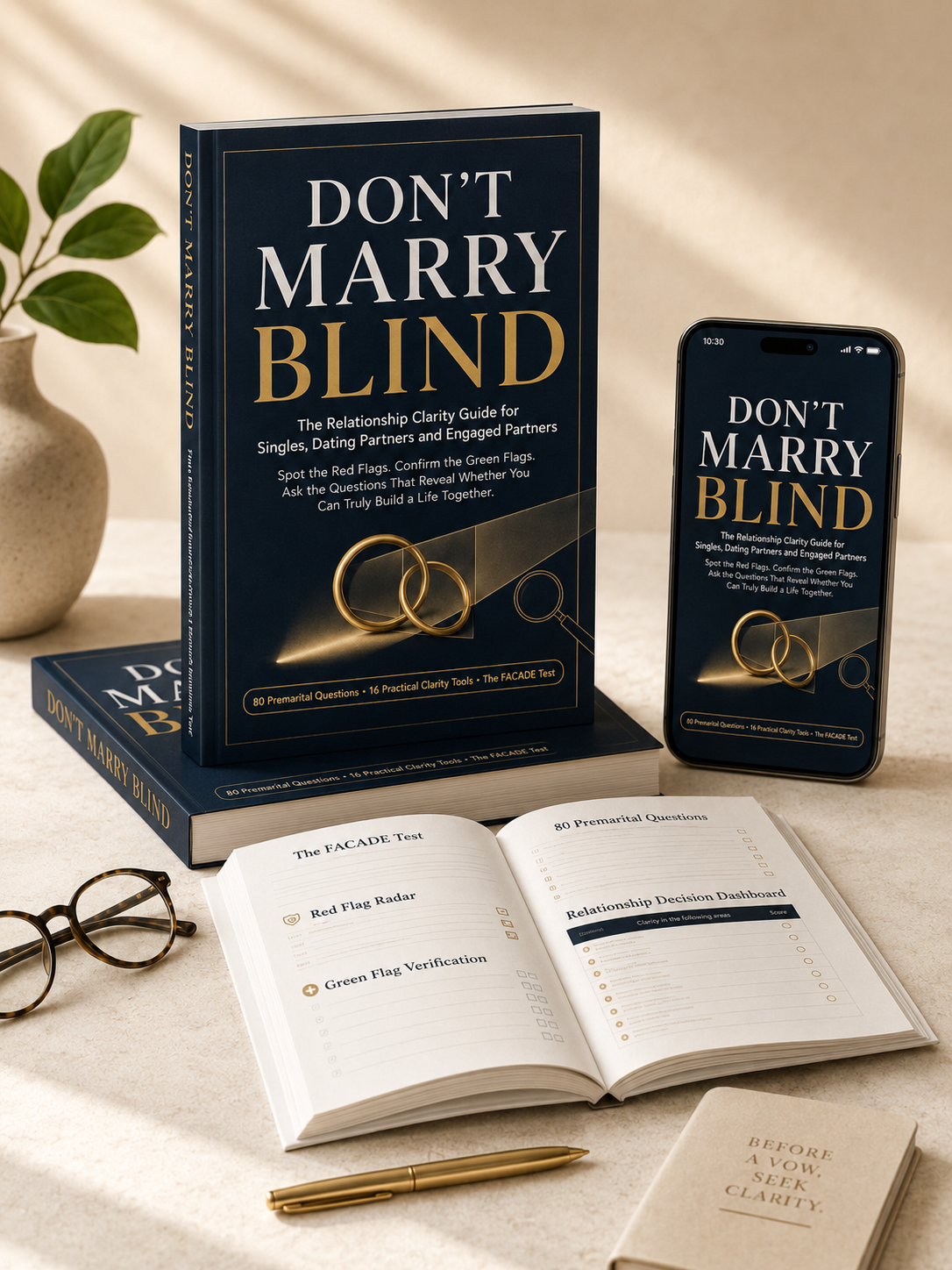
The Relationship Clarity Blueprint for Singles, Dating Partners and Engaged Partners
DON’T MARRY BLIND is a complete digital relationship clarity blueprint built around eighty premarital questions, sixteen practical tools and one clear journey: Reflect, Observe, Verify, Discuss and Decide.
It gives you a structured way to examine repeated behaviour, serious conversations, missing information, red flags, green flags, family expectations, money questions, faith, children, health, conflict and the practical realities that shape married life.
Forever is too long to be married to the wrong person. That is an error you should not make blindly.
What DON’T MARRY BLIND Is
DON’T MARRY BLIND is a digital relationship clarity blueprint/workbook designed to help singles, dating partners and engaged partners examine a relationship more carefully before marriage.
It is not a gossip guide. It is not a fear-based red flag list. It is not a tool for spying, trapping or manipulating your partner.
It is a structured workbook that helps you reflect, observe, verify, discuss and decide with better information.
Product Details
The 5-Step Relationship Clarity System
Reflect
Examine your motives, readiness, pressure, blind spots and the actual condition of the relationship.
Observe
Study natural behaviour across time, boundaries, inconvenience, correction and changing environments.
Verify
Compare answers, promises and apologies with existing patterns and measurable follow-through.
Discuss
Hold structured conversations about the issues that will shape everyday married life.
Decide
Determine whether to continue, slow down, pause and resolve, or walk away.
Everything Inside Has One Job: To Help You Make a Better-Informed Decision
This is not a book you read once, agree with and forget. It is a workbook you complete, return to and use to organise the evidence already available in your relationship.
1. Self-Clarity and Readiness Tools
These tools help you examine your own motives, maturity, pressure points and readiness before you begin judging another person.
Relationship Stage Identifier
Shows which parts of the blueprint matter most if you are single and preparing, newly dating, courting intentionally, engaged or recovering from a failed relationship.
Personal Readiness Audit
Examines your motives, emotional maturity, honesty, conflict habits, family boundaries and readiness for commitment before you judge someone else.
Chemistry, Compatibility and Character Filter
Stops strong feelings and shared interests from being mistaken for proof that two lives are aligned.
2. Red Flag, Green Flag and Pattern Tools
These tools help you stop treating isolated incidents, sweet explanations or attractive behaviour as enough evidence.
Weighted Red Flag Radar
Classifies 25 red flags as critical danger signs, serious warnings or investigation signs — with safety concerns overriding every numerical score.
Red Flag Incident Log
Helps you record what happened, whether it repeated, how the person responded when addressed and whether anything genuinely changed.
Green Flag Verification Profile
Assesses 20 healthy behaviours through consistency, context, cost, pressure and time.
Words Versus Evidence Sheet
Places what was said beside what repeatedly happens so a polished answer does not end the matter too early.
3. Observation and Pressure-Test Tools
These tools help you observe behaviour across ordinary life, pressure, boundaries, disappointment and changing environments.
FACADE Test Scorecard
Organises evidence around follow-through, accountability, consistency, unrewarded action, disappointment and evidence over explanations.
Public-Private Consistency Map
Compares behaviour in private, public, family, friendship, work, faith and online settings — including treatment of people with less social power.
Boundary Response Tracker
Records what happens after you say no, slow something down, disagree or express discomfort.
Pressure and Inconvenience Observation Sheet
Examines behaviour during financial pressure, fatigue, embarrassment, delays, mistakes, career problems and family conflict.
4. Conversation, Compatibility and Decision Tools
These tools help you ask the questions that matter, classify what the answers reveal and decide whether to continue, slow down, resolve or walk away.
80 Questions and Evidence Conversations
Covers marriage roles, character, faith, family, children, fertility, money, career, relocation, home life, health, intimacy and conflict.
Compatibility Gap Matrix
Classifies each issue as aligned, manageable, negotiable, a major incompatibility, a deal-breaker, a safety issue or insufficient evidence.
Final Relationship Decision Dashboard
Combines the relationship’s strengths, warnings, contradictions, agreements and missing information into one deliberate decision process.
Premarital Readiness Checklist
Confirms that material disclosures, essential conversations, medical screening, financial obligations, family boundaries and conflict plans have been addressed.
30/60/90-Day Clarity Review Plan
Helps you monitor follow-through, verify change, revisit unresolved agreements and repeat the decision process before marriage.
A Small Look Inside DON’T MARRY BLIND
I cannot place the entire blueprint on this page. But clarity often begins with noticing what everybody else keeps calling “small.”
They Respect Your Boundary—Then Punish You for It
Your partner does not have to shout, threaten or physically force you for a boundary to be violated.
Pay attention to what happens after you say, “No,” “Not yet,” “I am not comfortable with that,” or “I need more time.”
The issue may not be the request itself. The real issue may be how the person responds when access is denied.
Inside the full blueprint: the Boundary Response Tracker helps you separate ordinary disappointment from pressure, punishment and emotional control.
Every Incident Has an Explanation—but the Pattern Never Changes
One forgotten promise can be human.
One late arrival can be a mistake.
But when every broken commitment comes with a moving story, a convincing excuse or a new person to blame, stop judging only the explanation.
Ask the harder question:
Inside the full blueprint: the Words Versus Evidence Sheet helps you place what was said beside what repeatedly happened—so charm does not erase the pattern.
They Use Threats, Fear or Shame to Force Compliance
A person may not touch you physically and still use fear to take away your freedom to choose.
Pay attention to what happens when your answer is “No,” “Not now,” “I need to think,” or “I cannot continue like this.”
The issue is not only the disagreement. The real issue is when fear, shame or threats become the price you must pay for saying the truth.
Inside the full blueprint: the Weighted Red Flag Radar treats threats, coercion and intimidation as safety issues that override every numerical score.
Seven Premarital Questions Worth Asking
Seven Questions That Can Expose Years of Hidden Assumptions
These are the kinds of questions many people postpone during dating or courtship — and later discover that love did not automatically answer them.
- What income, debts, loans, savings, dependants and regular financial obligations must each of us disclose before marriage?
- Do we both want children, and how many would we ideally want if circumstances allowed?
- If conception is delayed for several years, what medical, emotional and spiritual steps would we take together?
- How involved should parents and relatives be in our marriage decisions, and who is responsible for setting boundaries with each side of the family?
- Where do we expect to worship or belong spiritually after marriage, and what faith practices are non-negotiable for each of us?
- How important is each person’s career, business, education or ministry compared with other family priorities?
- Under what circumstances would either person relocate to another city, state or country — and are we willing to maintain a long-distance marriage for work, study or immigration?
Those are only seven. The complete blueprint contains eighty premarital questions covering faith, family, fertility, children, money, health, intimacy, work, relocation, domestic life, personal history and conflict.
This Is Not About Catching Someone
DON’T MARRY BLIND does not teach you to spy, trap, manipulate or test your partner secretly.
It does not ask you to create fake social media accounts. It does not ask you to provoke jealousy. It does not ask you to check phones, guess passwords or manufacture situations.
That is not clarity. That is fear wearing the clothes of wisdom.
This blueprint teaches you to pay attention to what ordinary life is already revealing. It teaches you to ask direct questions, record patterns honestly, distinguish privacy from secrecy and know when a matter requires more conversation, more time, professional support or safety action.
Safety note: If there is violence, coercion, stalking, threats, sexual pressure, financial exploitation or immediate danger, do not use this workbook as your first response. Prioritise safety and seek trusted or professional help.
A Note From the Creator
DON’T MARRY BLIND was created for people who want to make relationship decisions with wisdom, not pressure.
Too many people enter marriage with unanswered questions because they are afraid of appearing difficult, ungrateful, suspicious or unserious. This blueprint was built to help you slow down, observe what is already visible, ask better questions and recognise the difference between promises, patterns and proof so you do not fall for pretence and deception.
The goal is not to make you fearful. The goal is to help you become clear.
Get the Complete DON’T MARRY BLIND Blueprint Today for ₦3,900
The complete package brings the blueprint, twenty-five red flags, twenty green flags, the FACADE Test, eighty premarital questions, sixteen practical tools and the 30/60/90-Day Clarity Review Plan into one structured system.
Retail price: ₦9,600
Today’s introductory price: ₦3,900
International access: $6.97
International access: $6.97
Introductory price available for the first 50 confirmed buyers.
Get DON’T MARRY BLIND for ₦3,900After payment, Selar gives you immediate digital access to download the blueprint.
Everything You Receive Today
- DON’T MARRY BLIND — the complete relationship clarity blueprint
- The 5-Step Journey: Reflect, Observe, Verify, Discuss and Decide
- The 6-Part FACADE Test
- 25 weighted red flags with danger, warning and investigation levels
- 20 green flags tested through consistency, context, cost, pressure and time
- 80 Premarital Questions and Evidence Conversations
- 16 practical audits, trackers, worksheets and decision tools
- 30/60/90-Day Clarity Review Plan
- 30-Day Fair Refund Protection
Retail price: ₦9,600
Today’s price: ₦3,900 / $6.97
Instant digital access after payment. Download the blueprint and begin organising what you have seen, what you have assumed and what still needs an honest conversation.
Frequently Asked Questions
Is DON’T MARRY BLIND only for women?
No. The blueprint is written for both men and women because either person can be misled by charm, pressure, beauty, promises, softness, attention, public approval or temporary good behaviour.
Do I need to be engaged before using the blueprint?
No. You can use it while getting to know someone, inside a serious dating relationship, during courtship or after engagement.
Is this a PDF or a physical book?
DON’T MARRY BLIND is a digital blueprint/workbook. After payment, you get instant digital access through Selar.
Can I use it without my partner?
Yes. You can use it privately first to organise your own thoughts, concerns and observations. Some sections are for personal reflection. Some sections can later guide honest conversations with your partner.
Can couples use it together?
Yes. Dating partners, courting couples and engaged couples can use it together to discuss money, family, faith, children, fertility, conflict, health, expectations and long-term compatibility.
Will this make me suspicious?
No. The blueprint is not designed to make you suspicious. It helps you observe what is already happening, ask clearer questions and stop calling missing information a green flag.
Is it religious?
DON’T MARRY BLIND is faith-friendly, but practical. It respects prayer, wisdom and moral seriousness while giving structured tools for observation, discussion and decision-making.
How do I receive it after payment?
After payment, Selar gives you immediate digital access to download the blueprint.
Why is the price this low?
The goal of this introductory release is to make relationship clarity accessible. Marriage is too serious for money to be the reason someone avoids the right questions or walks into forever without clarity.
What does the 30-Day Fair Refund Protection cover?
If you get DON’T MARRY BLIND, open it, and feel it does not help you organise your relationship concerns more clearly, contact us within 30 days and we will refund you. The protection is there because the blueprint should match what this page promised: practical clarity, structured questions, red flag and green flag tools, and a clearer way to examine relationship patterns before marriage.
Will the blueprint tell me whether to marry or leave?
No blueprint should make that decision for you. It helps you identify what is healthy, what needs further discussion, what requires change and what may be too serious to ignore.
What if my partner gives perfect answers to every question?
A beautiful answer is only the beginning. The blueprint asks you to compare the answer with present behaviour, past choices, practical plans and follow-through over time.
What if my partner refuses to answer the questions?
How a person responds to reasonable questions about a shared future is also information. Avoidance, anger, ridicule, vagueness and punishment should not be ignored.
What if I am afraid my past is making me suspicious?
The blueprint begins with personal reflection so you can separate old wounds from present evidence and avoid punishing a healthy person or ignoring an unhealthy pattern.
What if we have already started wedding plans?
Use the blueprint urgently, but not carelessly. Start with money, debt, children, family boundaries, faith, health, sex, relocation, conflict and deal-breakers.
Does this guarantee that my partner will never change after marriage?
No. No honest person can guarantee another human being’s future behaviour. The purpose is to help you stop ignoring the evidence available now.
What if there is violence, coercion or immediate danger?
This blueprint is not a substitute for urgent safety support. If there is violence, coercion, stalking, threats, sexual pressure, financial exploitation or immediate danger, prioritise your safety and seek trusted support, qualified professionals or appropriate local emergency services.
Imagine Knowing What You Are Actually Deciding
Imagine no longer replaying the same confusing conversation every night, not because every question has been answered, but because you can finally name what is missing.
You know what must be discussed. You know what must be observed. You know what has evidence. You know what still needs time. You know what should not be ignored.
You do not have to keep using chemistry, family approval, prayer, age pressure or wedding momentum to cover questions that still need answers.
You can love someone and still seek clarity.
30-Day Fair Refund Protection · Instant digital access · Secure checkout
Short Disclosure: DON’T MARRY BLIND is an educational relationship-clarity workbook. It is not therapy, legal advice, medical advice or financial advice. If there is violence, coercion, stalking, threats, sexual pressure, financial exploitation or immediate danger, prioritise safety and seek trusted or professional help.